

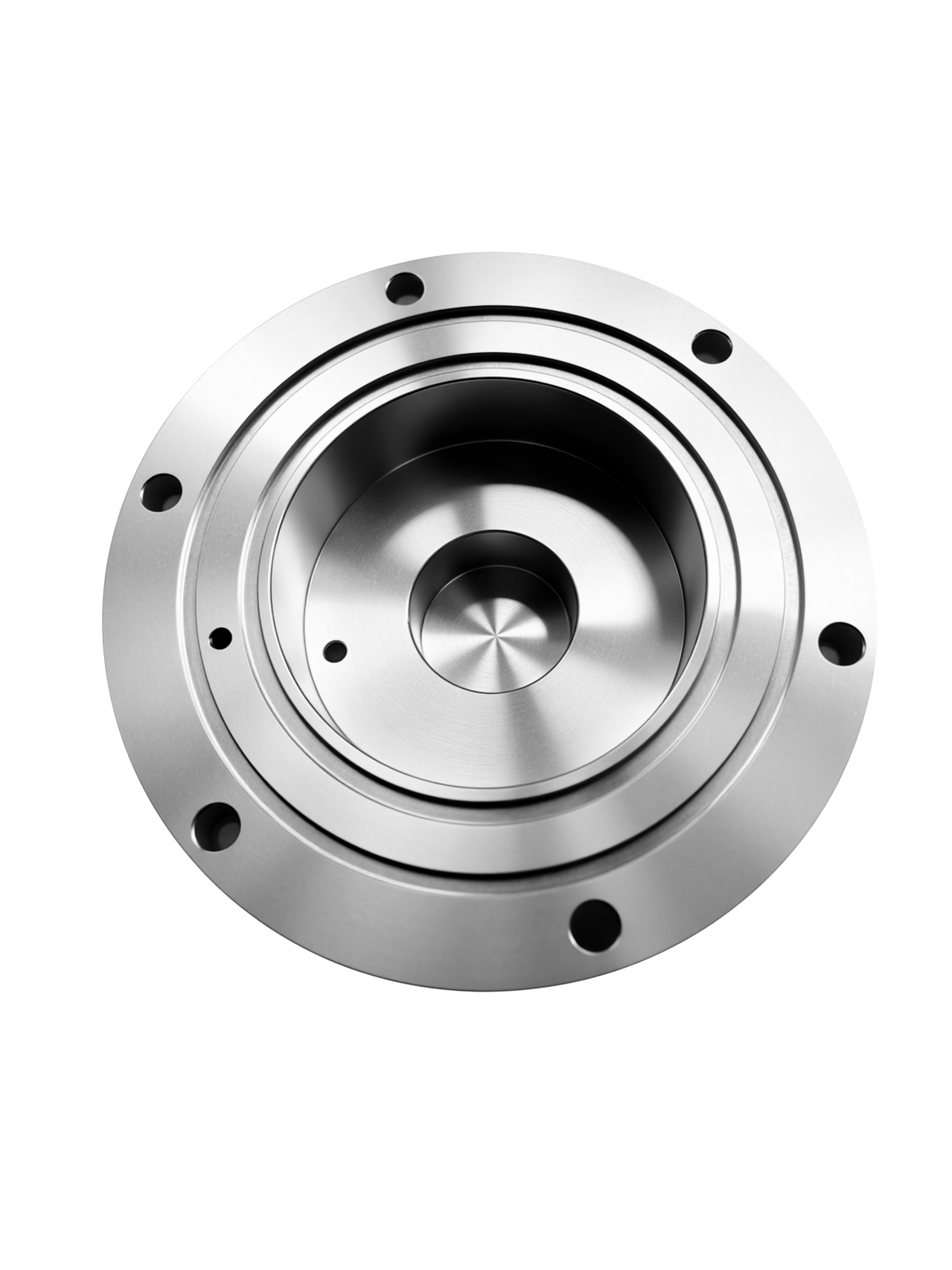
A vacuum line is reassembled with a new O-ring, but the system still fails its leak check. The natural response is to tighten the clamp again or order another seal. Before doing either, review the complete connection.
A KF vacuum flange joint depends on the flange faces, centering ring, O-ring, and clamp working together. Replacing one component does not establish that the others are clean, correctly matched, and properly seated. A systematic inspection helps maintenance teams decide what needs attention and what evidence to collect before purchasing replacements.
1. Confirm the Complete Connection
KF connections are also commonly described as NW or QF. Their nominal size identifies a connection family rather than the measured outside diameter of an O-ring.
Record the flange designation and check the supplier’s dimensional drawing. Match both flanges, the centering assembly, and the clamp. If the installation includes an adaptive centering ring or a bulkhead connection, identify that arrangement explicitly.
For a loose replacement O-ring, confirm its inside diameter, cross-section, and specified compound against the correct centering-ring assembly. A ring that stretches onto the support is not necessarily the correct replacement. Where the existing hardware cannot be identified, request dimensional verification before ordering by appearance.
2. Inspect the Parts as a Set
Use the equipment’s approved shutdown and venting procedure before opening the joint. Keep removed parts on a clean surface and protect the exposed vacuum ports.
Inspect the O-ring for cuts, embedded particles, distortion, or an uneven seating position. Examine both flange sealing faces and the centering ring for contamination and visible damage. Check the clamp’s hinge, closure, and contact surfaces.
Document findings before cleaning or replacing parts. Close-up photographs of the sealing faces, ring assembly, and clamp can make a supplier inquiry more useful than a photograph of the assembled line alone.
Use cleaning materials compatible with the seal compound and metal components, following the equipment supplier’s procedure. Prevent lint and residue from remaining on the sealing surfaces, and keep cleaned parts protected until reassembly.
3. Align the Joint Before Closing the Clamp
The centering ring positions the seal between the mating flanges. Bring the connection together with the ring correctly seated and the O-ring lying evenly around it.
Check that the pipework allows the flanges to meet without using the clamp to pull a displaced line into position. Review nearby supports if the connection repeatedly shifts when opened. Treat this as an installation issue to assess, rather than compensating with additional clamp force.
Follow the instructions for the specific clamp design. MKS describes hand tightening its wing-nut version until metal contact is felt, while toggle and bulkhead clamps use different closure arrangements. That instruction should not be converted into one universal torque value for every KF clamp.
For a correctly matched standard assembly, further tightening after the intended seating condition is reached does not improve the seal. If closure feels abnormal, reopen and inspect the joint.
4. Verify the Compound Against the Actual Service
A dimensionally correct O-ring can still be unsuitable for the process. Review the exact compound against the gases, vapors, cleaning agents, and temperatures it encounters.
Vacuum seal selection also involves gas permeation, compression set, and material weight loss under vacuum. Temperature compatibility alone is therefore insufficient. Ask for compound-specific information instead of assuming that a broad elastomer family name guarantees performance.
Include occasional operating conditions in the review: cleaning, warm equipment surfaces, and any specified heating cycle may differ from normal room-temperature operation.
Use lubricant only where the equipment or seal supplier permits it, with a product and quantity suitable for the application. Lubrication requirements deserve particular attention in processes sensitive to contamination.
5. Separate a Joint Leak from Other Gas Loads
Failure to reach the target pressure does not, by itself, locate a leak at the recently opened flange. Gas release from chamber walls and seals can also limit vacuum performance.
Compare the result with a documented baseline under similar conditions. Record the starting condition, evacuation time, process load, and any recent cleaning or maintenance.
A pressure-rise test can support investigation of the gas load, but it does not identify the leaking connection. Where localization is required, use an appropriate leak-detection method, such as helium leak testing, with trained personnel and a defined procedure.
Agree the acceptance criterion before testing. Specify the method, units, test conditions, and relevant system boundary so that the result can be compared with the maintenance requirement.
6. Order the Component That Addresses the Finding
Use the inspection record to prepare a focused replacement inquiry:
| Finding | Information to send the supplier |
|---|---|
| Suspected incorrect O-ring | Flange designation, ring dimensions, and centering assembly details |
| Damaged centering ring | Photographs, bore dimensions, and mating-flange information |
| Abnormal clamp closure | Clamp type, size, condition, and connection photographs |
| Suspected seal incompatibility | Compound identification, process media, and temperature history |
| Damaged flange face | Close-up images, component drawing, and observed test result |
Ask the supplier to confirm the matched assembly and its application limits. Include any operating condition above atmospheric pressure; suitability for that condition must be established for the specific components.
For a RockVito inquiry, provide the KF size, component photographs or drawings, required quantity, and service conditions. Request a complete matched set when the existing parts cannot be identified confidently. After installation, repeat the agreed test and retain the result with the maintenance record.
-768x768.png)